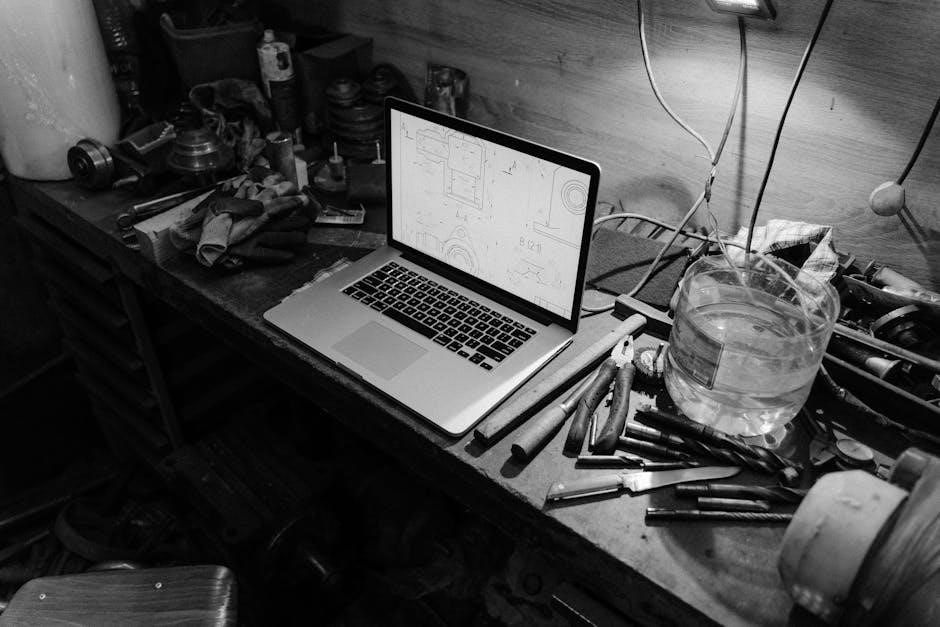
Clutch diagrams visually represent the core components – flywheel, pressure plate, disc, and bearing – illustrating how they interact to transmit engine power effectively.
What is a Manual Transmission Clutch?
A manual transmission clutch is a mechanical device that engages and disengages the engine’s power from the transmission, allowing for gear changes. Clutch diagrams are essential for understanding this process, showcasing the key components working in unison. These diagrams typically illustrate the flywheel, bolted to the engine’s crankshaft, the pressure plate applying clamping force, and the clutch disc – the friction material transmitting power.
The release bearing, activated by the clutch pedal, disengages the pressure plate, interrupting power flow. Understanding a clutch diagram reveals how these parts interact. It’s located within the engine crankcase, facilitating smooth shifts and controlled vehicle movement. Visualizing this system through a diagram aids in troubleshooting and repair, offering a clear representation of its operational mechanics.
Purpose of a Clutch Diagram
A clutch diagram’s primary purpose is to visually demystify the complex interaction of components within a manual transmission system. It serves as an invaluable tool for mechanics, students, and enthusiasts seeking to understand the clutch’s operation. These diagrams clearly illustrate the flywheel assembly, pressure plate mechanism, diaphragm spring function, and the clutch disc’s role in power transfer.
Furthermore, a clutch diagram aids in identifying parts during repair or replacement, like the starter clutch components (housing, shoes, nuts) and the clutch plate lockring. It simplifies troubleshooting common failures and understanding the clutch linkage. By providing a schematic overview, it enhances comprehension of the entire system, from engagement to disengagement, and even advanced technologies like dual-clutch transmissions.

Core Components of a Manual Clutch System
Essential components include the flywheel, pressure plate, diaphragm spring, release bearing, and driven disc, working in harmony to smoothly connect and disconnect engine power.
Flywheel Assembly
The flywheel, a robust disc bolted to the engine’s crankshaft, serves multiple crucial functions within the manual transmission system. Beyond its primary role in storing rotational energy, smoothing engine operation, and facilitating starter engagement, it provides a friction surface for the clutch disc. A clutch diagram clearly illustrates the flywheel’s position and its precisely machined surface.
This surface is vital for consistent clutch engagement. The flywheel’s weight contributes to the engine’s inertia, reducing vibrations. It’s a heavy component, often made of cast iron or steel, designed to withstand significant heat and stress generated during clutch operation. Examining a clutch diagram reveals how the flywheel interacts directly with the pressure plate and clutch disc, forming the core of the clutch assembly.
Pressure Plate Mechanism
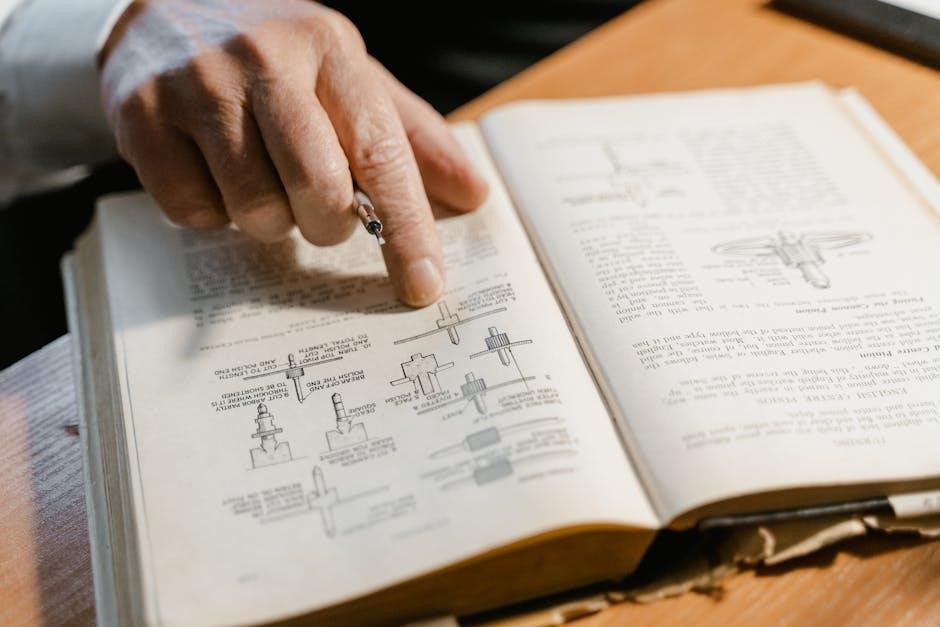
The pressure plate, a key component visible in any detailed clutch diagram, exerts constant clamping force against the clutch disc and flywheel. This force is essential for transmitting engine power to the transmission when the clutch is engaged. A clutch diagram showcases the pressure plate’s construction, typically featuring a housing, diaphragm spring, and release fingers.
Its mechanism allows for controlled engagement and disengagement. When the clutch pedal is released, the diaphragm spring pushes the pressure plate firmly against the clutch disc. A clutch diagram highlights how the release fingers, when activated by the release bearing, overcome the spring’s force, disengaging the clutch. Precise engineering ensures smooth and reliable operation, preventing slippage and ensuring efficient power transfer.
Diaphragm Spring Function
A clutch diagram clearly illustrates the diaphragm spring’s crucial role within the pressure plate assembly. This conical spring provides the clamping force necessary to maintain engagement between the clutch disc and flywheel; Its design, visible in a detailed clutch diagram, allows for a progressive clamping action, ensuring smooth engagement and minimizing shock loads.
The spring’s function is to store energy when the clutch pedal is released, creating consistent pressure. When the clutch pedal is depressed, release fingers act upon the diaphragm spring, pivoting it inwards and relieving the clamping force. A clutch diagram demonstrates this action, showing how the spring’s deformation allows for disengagement. Its durability and consistent performance are vital for reliable clutch operation.
Clutch Disc (Driven Plate) Details
A comprehensive clutch diagram highlights the clutch disc’s key features. Positioned between the flywheel and pressure plate, this driven plate transmits engine power to the transmission. The diagram reveals its construction: a steel center hub, friction material bonded to both sides, and torsional damping springs. These springs absorb shocks and vibrations, ensuring smoother gear changes and reducing drivetrain stress.
The friction material, visible in a detailed clutch diagram, is crucial for grip. Wear on this material reduces clamping force. The diagram also shows splines connecting the disc to the transmission input shaft. Proper alignment, as shown in the clutch diagram, is essential for smooth operation and preventing premature wear. Understanding these details is vital for clutch system maintenance.
Release Bearing (Throw-Out Bearing) Operation
A detailed clutch diagram illustrates the release bearing’s critical role. This bearing, also known as the throw-out bearing, disengages the clutch by pushing on the pressure plate. The diagram shows its positioning against the diaphragm spring fingers. When the clutch pedal is pressed, the bearing moves forward, relieving pressure on the clutch disc.

The clutch diagram reveals the bearing’s constant motion during clutch engagement and disengagement. It’s a wear item, requiring periodic inspection. A diagram also clarifies how the bearing slides on the release fork, transferring force from the clutch linkage. Proper lubrication, visible in some diagrams, is essential for smooth operation and preventing premature failure. Understanding this operation, as shown in the diagram, aids in troubleshooting clutch issues.
Clutch System Operation & Mechanics
A clutch diagram showcases the sequential process: pedal press disengages power, allowing gear changes, then re-engagement smoothly transfers engine torque.
Clutch Engagement and Disengagement Process
Clutch diagrams are invaluable for understanding this process. Initially, with the clutch pedal depressed, the pressure plate separates from the clutch disc, disconnecting the engine from the transmission – disengagement. This allows the driver to select a different gear without resistance.
As the pedal is slowly released, the pressure plate gradually clamps down on the disc, initiating engagement. Friction between the flywheel, pressure plate, and disc increases, progressively transferring engine power to the transmission. A clutch diagram clearly illustrates this increasing contact area.
Full engagement occurs when the pedal is fully released, creating a solid connection. The engine and transmission rotate as one, delivering power to the wheels. Studying a detailed clutch diagram reveals the precise mechanics of this vital power transfer sequence.
The Role of the Clutch Pedal
A clutch diagram highlights the pedal’s crucial function: controlling the pressure plate’s engagement and disengagement. Depressing the pedal initiates a mechanical linkage – or hydraulic system – that moves the release bearing. This bearing then pushes against the diaphragm spring, relieving pressure from the clutch disc.
The clutch diagram visually demonstrates how pedal travel directly correlates to the amount of pressure released. Partial depression allows for smooth starts and gear changes, while full depression completely disconnects the engine.
Releasing the pedal reverses this process, gradually reapplying pressure. Understanding this relationship, as shown in a clutch diagram, is fundamental to mastering manual transmission driving and preventing stalling or jerky shifts.
Understanding Clutch Linkage
A detailed clutch diagram reveals the intricate network connecting the clutch pedal to the release bearing. This linkage, often mechanical or hydraulic, translates pedal movement into precise action. Mechanical systems utilize rods and levers, while hydraulic systems employ a master and slave cylinder filled with fluid.
The clutch diagram illustrates how adjustments within the linkage are critical for proper operation. Incorrect adjustment can lead to incomplete clutch engagement, causing slipping or difficulty shifting.
Examining a clutch diagram helps visualize how wear and tear on linkage components – like bushings or cables – can affect performance. Smooth, consistent pedal feel and reliable clutch operation depend on a well-maintained linkage system, as clearly depicted in the schematic.
Types of Clutch Systems
Clutch diagrams showcase single-plate systems, common in most vehicles, and multi-plate designs used for high-performance applications demanding increased torque capacity.
Single-Plate Clutch Configurations
Diagrams of single-plate clutches reveal a straightforward design: a flywheel bolted to the engine, a pressure plate applying clamping force, and a single friction disc sandwiched between them. This configuration is prevalent due to its simplicity and cost-effectiveness. The diagram clearly illustrates how the pressure plate, driven by a diaphragm spring, engages and disengages contact with the flywheel and friction disc.
When engaged, the engine’s rotational force transfers through the flywheel, pressure plate, and disc to the transmission input shaft. Disengagement, initiated by the clutch pedal, releases the pressure plate, interrupting this connection. A detailed diagram highlights the key components – housing, shoes, and nuts – essential for proper operation. These systems are commonly found in 5-speed and 6-speed manual transmissions, offering reliable performance for everyday driving.
Multi-Plate Clutch Applications
Diagrams of multi-plate clutch systems showcase a more complex arrangement, utilizing multiple friction discs and pressure plates stacked together. This design dramatically increases the surface area for friction, enabling the transmission of significantly higher torque levels. These clutches are essential in applications demanding robust power handling, often exceeding the capacity of single-plate setups.
A detailed diagram reveals how each plate works in unison, providing increased clamping force and heat dissipation. While more intricate, the principle remains the same: engagement transfers power, and disengagement interrupts it. Such systems are frequently found in high-performance vehicles and heavy-duty commercial applications, including 6-speed dual clutch gearboxes. The diagram also illustrates the need for precise alignment and robust components to withstand the increased stress.
Clutch System Troubleshooting
Diagrams aid in pinpointing issues; a visual guide helps trace problems from the pedal, through linkage, to the pressure plate and friction disc.
Common Clutch Failure Symptoms
A clutch diagram becomes invaluable when diagnosing issues. Slipping, indicated by high engine RPMs with minimal acceleration, often points to a worn friction disc. Difficulty shifting, or gears grinding, can stem from problems within the linkage or pressure plate.
Unusual noises – squealing, rattling, or thumping – during clutch engagement or disengagement suggest a failing release bearing or diaphragm spring. A soft or spongy pedal feel might indicate air in the hydraulic system (if equipped) or a worn master/slave cylinder.
Furthermore, a clutch that doesn’t fully disengage, making gear selection difficult, could be due to a warped flywheel or improper adjustment. Referencing a detailed diagram helps isolate the faulty component, streamlining the repair process and ensuring accurate parts replacement.
Clutch Piping Systems (Mazda Example)
A clutch diagram, when examining hydraulic systems like those found in some Mazda manual transmissions, reveals the network of pipes and cylinders crucial for operation. These systems transmit force from the pedal to the release fork.
Mazda6 models (post-2002, European versions) utilize specific piping configurations, often involving a master cylinder, a slave cylinder, and connecting lines. These lines carry hydraulic fluid, enabling smooth clutch engagement and disengagement.
Diagrams illustrate the precise routing of these pipes, highlighting connection points and potential leak locations. Understanding this layout is vital for troubleshooting hydraulic clutch issues, such as a spongy pedal or difficulty shifting. Sourcing OEM Mazda parts ensures compatibility and reliability within this intricate system.

Advanced Clutch Technologies
Clutch diagrams for AMTs and DCTs showcase complex multi-plate designs and automated control systems, differing significantly from traditional manual setups.
Automated Manual Transmissions (AMTs)
AMT clutch diagrams reveal a fundamentally manual clutch system, but augmented with robotic actuators and a transmission control module (TCM). These diagrams illustrate how the clutch engagement and disengagement, traditionally driver-controlled, are now automated. The flywheel, pressure plate, and clutch disc remain core components, mirroring a standard manual setup. However, the key difference lies in the absence of a clutch pedal and the presence of actuators that mimic pedal operation.
These diagrams often highlight the hydraulic or electric systems responsible for controlling the clutch. They demonstrate how sensors monitor clutch position and pressure, feeding data back to the TCM for precise gear changes. Before the 2000s, manual transmissions were dominant in commercial vehicles, but AMTs have gained traction, offering fuel efficiency and reduced driver fatigue. Understanding the diagram helps visualize this evolution.
Dual-Clutch Transmission (DCT) Overview
DCT diagrams showcase a sophisticated system employing two separate clutches – one for odd-numbered gears and another for even-numbered gears. Unlike a standard manual clutch diagram with a single assembly, DCTs present a parallel configuration. This allows for pre-selection of the next gear, resulting in incredibly fast and seamless shifts. The diagrams illustrate how one clutch disengages as the other engages, minimizing power interruption.
Key components include two clutch packs, input shafts, and a complex control system. These diagrams often highlight the hydraulic or electro-mechanical actuators responsible for clutch operation. DCTs represent a significant advancement over AMTs, offering superior performance and responsiveness. They are increasingly common in high-performance vehicles, providing a blend of efficiency and driving enjoyment.
Shift Gate Mechanisms (Koenigsegg Example)
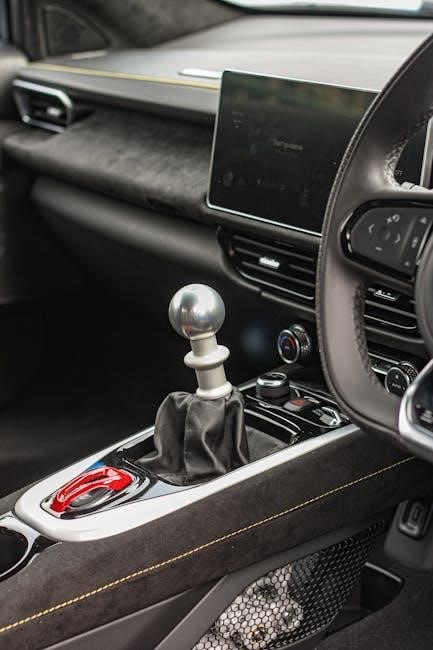
While a traditional clutch diagram focuses on the core clutch assembly, Koenigsegg’s innovative shift gate demonstrates a unique interface controlling that underlying mechanism. Diagrams of these systems reveal a complex linkage between the shift lever and the transmission, bypassing conventional paddles. The CC850 utilizes a slotted metal gate, requiring precise mechanical engagement for gear selection – a throwback to classic manual transmissions.
These diagrams showcase the intricate geometry of the gate, ensuring accurate gear placement. Though the clutch operation itself remains similar to a standard manual, the shift gate adds a layer of driver involvement and tactile feedback. It’s a fascinating blend of modern technology and nostalgic design, offering a uniquely engaging driving experience.

Clutch Parts and Identification
Clutch diagrams pinpoint components like the housing, shoes, nuts, lockrings, and clutch plates, aiding in identification for repair or replacement procedures.
Starter Clutch Components (Housing, Shoes, Nuts)
Clutch diagrams clearly delineate the starter clutch’s essential parts. The housing, often numbered 400 in parts lists, provides structural support and encasement for the internal mechanism. Within this housing reside the starter clutch shoes (art. 3446-227), crucial for engaging with the flywheel to initiate engine rotation.
These shoes are securely fastened using specific nuts (art. 3446-352), ensuring proper tension and functionality. A detailed diagram illustrates the precise arrangement and interaction of these components, vital for correct assembly and troubleshooting. Understanding their placement, as shown in the diagram, is key for maintenance and repair, particularly when replacing worn parts within the starter clutch assembly.
Clutch Plate Lockring and Kit Details
Clutch diagrams highlight the clutch plate lockring (9 149306), a critical component securing the clutch disc to the flywheel. This ring prevents axial movement, ensuring proper engagement and disengagement. Often, these are supplied within a comprehensive clutch kit (10 138986), which includes a new disc, pressure plate, and potentially a release bearing.
Diagrams also illustrate accompanying parts like thrust washers (11 025031; 60x50x4), which reduce friction and wear. A detailed clutch kit diagram showcases all included elements, aiding in verifying completeness before installation. Understanding the lockring’s position and function, as depicted in the diagram, is essential for a successful clutch replacement and optimal transmission performance.